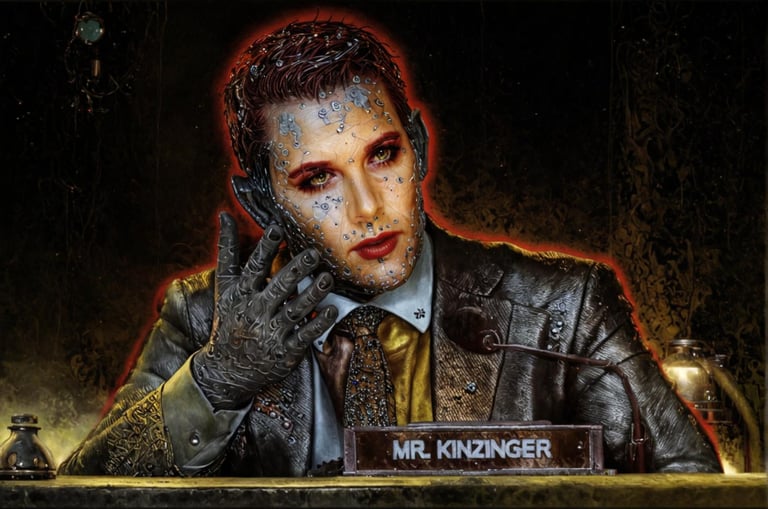
Alan Kinzinger #1
Foundations of Integrity - Bloomington, Illinois, isn’t the kind of place one expects to produce national political figures. It's a Midwest city filled with hardworking families, small businesses, and people who believe in lending a hand to their neighbors. It was in this setting that Alan Daniel Kinzinger was born on February 27, 1978, to Betty Jo and Rus Kinzinger. His mother was an elementary school teacher, and his father was a church pastor and hospital chaplain—careers dedicated to service and compassion. Alan grew up learning about faith, service, and resilience, often hearing his father say, “A leader isn’t afraid to sacrifice for something bigger.”
DJT
1/2/20255 min read
Foundations of Integrity
Bloomington, Illinois, isn’t the kind of place one expects to produce national political figures. It's a Midwest city filled with hardworking families, small businesses, and people who believe in lending a hand to their neighbors. It was in this setting that Alan Daniel Kinzinger was born on February 27, 1978, to Betty Jo and Rus Kinzinger. His mother was an elementary school teacher, and his father was a church pastor and hospital chaplain—careers dedicated to service and compassion. Alan grew up learning about faith, service, and resilience, often hearing his father say, “A leader isn’t afraid to sacrifice for something bigger.”
His parents taught him to admire leaders like Abraham Lincoln and Ronald Reagan, men who saw the nation as worth defending, no matter the cost. His Midwestern upbringing instilled in him a belief that democracy, though imperfect, was an ideal worth defending.
From an early age, Alan was a curious and empathetic child with a sharp sense of justice. He once broke up a playground scuffle between two boys when he was only in fifth grade. His teacher praised his courage, but Alan shrugged it off, saying, "Someone had to step in." That simple response—“Someone had to step in”—would later become his unspoken credo.
Kinzinger excelled in high school, earning strong grades and displaying leadership as a student council member. But while he was academically gifted, he felt a tug toward something bigger. He didn’t want to take the safe route of a predictable career—he wanted to serve.
In 1998, Kinzinger graduated from Illinois State University with a degree in political science. During his time there, his interest in global affairs deepened, as he became increasingly aware of America’s role as a world leader. His heart, however, was set on flying. He longed to soar above the world and see the nation he loved from the sky.
In the wake of the September 11, 2001 attacks, Kinzinger’s desire to serve turned into an unshakable resolve. Watching the twin towers collapse and hearing the cries of a stunned nation strengthened his commitment. “I wasn’t going to stand by when my country needed me,” he would later say. He joined the United States Air Force and began a journey that would take him across war-torn lands, testing his courage and character.
Kinzinger became a pilot for the Air National Guard and excelled during his training. His call sign—“Blitz”—reflected his fearless precision in the air. Over the years, he flew more than 100 combat missions in Iraq and Afghanistan, conducting reconnaissance and air support missions that saved lives. He witnessed firsthand the devastation of war—the destruction, the displaced families, and the soldiers who bore the scars of battle.
During one of his most harrowing missions in Iraq, Kinzinger’s aircraft came under fire from enemy forces. Instead of retreating, he maintained formation and completed the mission, ensuring the safety of ground troops under heavy attack. For his actions, he was awarded the Airman’s Medal, a distinction reserved for extraordinary acts of heroism.
Despite the chaos of war, Kinzinger’s sense of purpose grew stronger. “The stakes in battle aren’t about glory—they’re about duty,” he told fellow pilots. His service reaffirmed his belief that America’s strength wasn’t just in its military power but in the values it represented: liberty, fairness, and the belief that every citizen had a role in shaping the nation’s destiny.
The Aftermath of War
Kinzinger returned home with the quiet dignity of someone who had served honorably. Though he never boasted about his military accolades, they spoke volumes: a Bronze Star, a Combat Action Medal, and deep respect from those who had flown with him. He struggled, however, with the disconnect between the sacrifices made overseas and the growing political division he saw at home.
Veterans like Kinzinger often returned from war with a heightened sense of responsibility. They had risked everything, and in return, they wanted to see their leaders uphold the ideals they had fought for. But by the mid-2000s, Kinzinger was disillusioned by the increasingly partisan nature of Washington. He watched as political figures dug in their heels, putting party power above national unity.
This disillusionment didn’t break his spirit—it fueled a new purpose. "The fight for America’s future doesn’t just happen on the battlefield," he thought. The war at home, where truth and unity were at stake, was just as important. He began contemplating a run for political office, determined to bring the same sense of duty and accountability to Congress that he had carried in the cockpit.
A Reluctant Politician
In 2009, Alan Kinzinger made the leap into politics, running for Congress in Illinois' 16th Congressional District. His campaign wasn’t built on political theater but on his personal story of service and his desire to help bridge America’s divides. "I’m not here for power," he told voters. "I’m here because I believe in the promise of this country."
With his conservative credentials, focus on national security, and commitment to local communities, Kinzinger resonated with voters. He didn’t shy away from difficult conversations—whether about taxes, healthcare, or military spending—but he always made it clear that his allegiance was to his constituents and to the nation, not to party leaders or political interests.
In 2010, the Tea Party wave swept through the nation, propelling Kinzinger and other Republicans into Congress with promises to curb government overreach and strengthen America’s defenses. However, even as Kinzinger celebrated his victory, he remained cautious. He didn’t want to become another cog in the partisan machine.
The Heart of a Patriot
Kinzinger’s years of service as a congressman were marked by a thoughtful, measured approach. He supported conservative policies but refused to give in to political theater. While many members of Congress sought the spotlight, Kinzinger was content to focus on his work, building a reputation as a leader who understood the weight of his office.
His colleagues, both Republican and Democrat, often spoke of his respect for the institution of democracy. "Alan’s one of the few who actually listens before he speaks," a fellow congressman remarked. He also became a champion for veterans, introducing legislation that expanded mental health services and funding for military families.
Kinzinger was particularly vocal about foreign policy, believing that America had a responsibility to support its allies and oppose authoritarian regimes. When he criticized America’s withdrawal from Syria in 2019, warning that it would embolden U.S. adversaries, he showed that his principles mattered more than political expediency.
Foreshadowing the Battle Ahead
As the Trump presidency gained momentum, Kinzinger began to sense a troubling shift within the Republican Party. What had once been a party that celebrated service and patriotism was transforming into something different—a party increasingly driven by fear, conspiracy, and loyalty to one man rather than to the Constitution.
In private conversations, Kinzinger warned colleagues about the dangers of prioritizing loyalty to a leader over loyalty to the country. "We didn’t swear an oath to a man. We swore an oath to the Constitution," he reminded them. But his warnings often fell on deaf ears.
By the time the 2020 election approached, Kinzinger found himself at a crossroads. The nation he had fought to defend was now at risk of imploding—not from foreign enemies, but from within. He knew that the coming months would test him in ways even war had not.
But Alan Kinzinger wasn’t afraid.
He had been preparing for this moment his entire life.