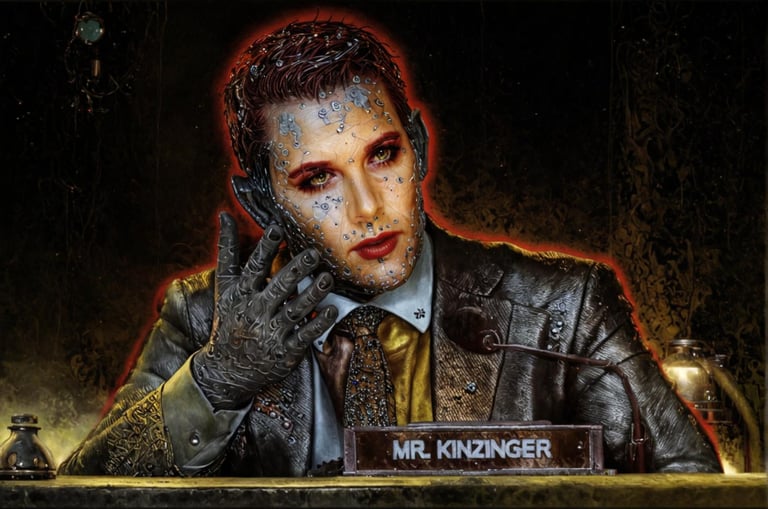
Alan Kinzinger #3
The Breaking Point—January 6th, 2021 - The morning of January 6, 2021, dawned cold and quiet in Washington, D.C. To many, it seemed like any other day. But Adam Kinzinger knew it wasn’t. The previous weeks had been a crescendo of chaos, driven by President Trump’s refusal to accept the outcome of the election. The rhetoric had reached a fever pitch. Claims of voter fraud—debunked repeatedly—had metastasized into something darker: a call to action.
DJT
1/4/20254 min read
The Breaking Point—January 6th, 2021
The morning of January 6, 2021, dawned cold and quiet in Washington, D.C. To many, it seemed like any other day. But Adam Kinzinger knew it wasn’t. The previous weeks had been a crescendo of chaos, driven by President Trump’s refusal to accept the outcome of the election. The rhetoric had reached a fever pitch. Claims of voter fraud—debunked repeatedly—had metastasized into something darker: a call to action.
In his office that morning, Kinzinger adjusted his tie and glanced at the television. The news showed crowds gathering for Trump’s planned rally near the White House. Trump’s supporters, wrapped in flags and holding banners, had come from across the country to protest what they had been led to believe was a "stolen election." Kinzinger shook his head.
"This isn’t a protest," he muttered to an aide. "It’s a powder keg."
For weeks, Kinzinger had been one of the few Republican voices condemning Trump’s incendiary language. The president had insisted that Vice President Mike Pence could overturn the election results when Congress met to certify Joe Biden’s victory. But that wasn’t how the Constitution worked, and Kinzinger was vocal about it.
"The vice president doesn’t have that power. And the president knows it," he told reporters the day before. His words had earned him more hate mail, more online threats, and even veiled warnings from political allies. But Kinzinger didn’t care about the backlash. His duty to defend democracy mattered more.
He knew what many of his Republican colleagues refused to admit: Trump’s lies about the election were pushing America to the brink of violence.
Around noon, as Kinzinger watched from his office window, the unthinkable began to unfold. He could hear faint chants growing louder in the distance. The president had finished speaking at his rally, urging his supporters to march to the Capitol and "fight like hell." Within an hour, a mob swarmed the Capitol steps.
The barricades fell almost instantly. Security officers were overrun as rioters in tactical gear scaled walls, smashed windows, and surged inside. The halls that Kinzinger had walked for years—symbols of democracy’s strength—were under siege.
Kinzinger’s phone buzzed. A message from a colleague read: "Get to a safe place." But Kinzinger didn’t move. He stood frozen, watching the chaos on the screen as images of the House Chamber flashed—representatives crouching under desks, gas masks handed out. Officers barricaded the doors with furniture as rioters pounded on them.
Kinzinger clenched his fists. "This is a coup attempt," he whispered, horrified.
In those terrifying moments, Kinzinger thought back to his oath. He had taken it as an Air Force pilot, and he had taken it again as a congressman: to protect and defend the Constitution against all enemies, foreign and domestic. He had never imagined that "domestic enemies" would include his fellow Americans, driven to violence by lies.
Kinzinger's office door was locked, but he could hear distant shouts and crashes from the halls outside. His aides urged him to retreat to a secure location, but Kinzinger refused. He knew he couldn’t stop what was happening, but he wasn’t going to cower.
Instead, he began making calls—to reporters, to colleagues, to staff—demanding that they document what was unfolding. "The American people need to see this for what it is," he told a reporter from The Atlantic. "This is the direct result of a lie."
As the sun set over a Capitol still shrouded in smoke and fear, the rioters were finally cleared. The halls were littered with shattered glass, overturned desks, and discarded flags. A noose had been erected outside. Offices were ransacked. But Congress returned that night, determined to finish what they had started: certifying the election.
Kinzinger sat silently at his desk as the roll call began. His heart was heavy, but his resolve was unbreakable. He knew that while the immediate crisis had passed, a new battle for America’s future had just begun.
In the days that followed, Kinzinger became one of the first Republicans to demand that Trump be held accountable. "He lit the match," Kinzinger said in a press conference. "This wasn’t spontaneous. This was incited."
His public condemnation of Trump was a watershed moment. Many of his colleagues stayed silent or issued lukewarm statements. Some even doubled down on Trump’s election lies, terrified of alienating the party’s base. But Kinzinger didn’t hesitate to call for Trump’s impeachment.
"How can we call ourselves patriots if we excuse sedition?" he asked in a powerful floor speech. "If standing up for the truth costs me my career, so be it."
The backlash was swift and brutal. Kinzinger’s family disowned him in a scathing letter, accusing him of betraying his faith and his party. His voicemail filled with death threats. His staff was harassed online. But none of it shook his belief in his cause.
"Leadership is about doing the right thing, even when it’s lonely," Kinzinger told his closest friends.
Months later, Kinzinger became one of only two Republicans to join the House Select Committee on January 6th, tasked with investigating the attack and holding those responsible accountable. Alongside fellow Republican Liz Cheney, Kinzinger faced relentless attacks from within his own party.
But his testimony during the public hearings was unflinching. He spoke about the lasting damage to America’s institutions and the dangers of normalizing political violence. At times, his voice cracked with emotion, but his words were clear: "If we don’t hold those responsible accountable, January 6th won’t be the end—it will be the beginning of something far worse."
As the hearings concluded, Kinzinger announced that he would not seek re-election in 2022. He knew his stance had made him a pariah in his party, but he had no regrets. "This isn’t about winning or losing elections," he said in a farewell speech. "It’s about preserving the Republic."
He left Congress with his head held high, having sacrificed his political future for the truth. But his fight wasn’t over. In the months that followed, Kinzinger launched the "Country First" movement, aimed at promoting unity, accountability, and a return to principled leadership.
On January 6, 2022, exactly one year after the attack, Adam Kinzinger stood on the Capitol steps as bells rang in remembrance of the fallen. The sky was clear and cold, but this time, there was no chaos—only the quiet resolve of a nation still healing.
For Kinzinger, the fight for democracy had never been about politics—it had always been about honor. And as he looked up at the Capitol dome, he felt the same unshakable pride he’d felt as a young pilot in the skies over Iraq. He had kept his oath.
He had done his duty.