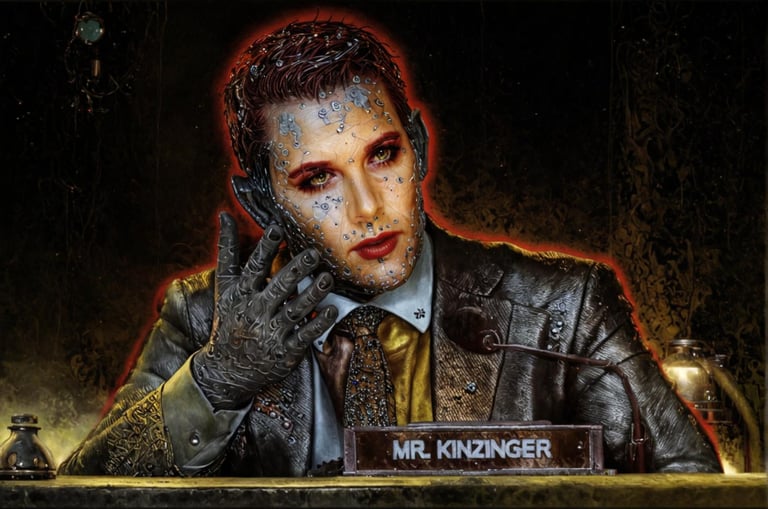
Alan Kinzinger #4
The Breaking Point—January 6th, 2021 - The morning of January 6, 2021, dawned cold and quiet in Washington, D.C. To many, it seemed like any other day. But Adam Kinzinger knew it wasn’t. The previous weeks had been a crescendo of chaos, driven by President Trump’s refusal to accept the outcome of the election. The rhetoric had reached a fever pitch. Claims of voter fraud—debunked repeatedly—had metastasized into something darker: a call to action.
DJT
1/5/20254 min read
After the Fire—A New Legacy
The day Adam Kinzinger left his congressional office for the last time in January 2023 was unusually quiet. Most members of Congress were already preparing for the next legislative session, while reporters waited outside for a parting statement from the Republican-turned-political pariah. But Kinzinger didn’t need a microphone that day. His message had already been made clear through his actions.
He paused briefly at the Capitol steps, taking in the grand marble pillars. For years, this building had been a beacon of democracy to him—a place where heated debates still ended with a handshake and where policy could still rise above partisanship. But that version of the Capitol had grown distant. The January 6th attack had turned it into a battleground, both physically and ideologically.
But Kinzinger had done what he believed was right. Even if it had cost him his political career, his friendships, and even ties with his family, he had defended the truth. That, he thought, was legacy enough.
The weeks following his departure from Congress were bittersweet. He returned to Illinois, where he and his wife, Sofia, settled into a quieter routine. Their son, Christian, was just a baby—too young to understand the gravity of his father’s decisions but central to Kinzinger’s renewed sense of purpose.
"I need to be able to tell him that I did everything I could," Kinzinger told a friend over coffee one morning. "If that’s all I have to offer him, it’s enough."
Yet, stepping away from Congress didn’t mean stepping away from the fight for democracy. The wounds of January 6th had not healed, and the political landscape remained volatile. Kinzinger knew that his role in history wasn’t over—it was simply evolving.
In early 2023, Kinzinger launched "Country First," a political movement aimed at rebuilding faith in democratic institutions and promoting truth over party allegiance. The name wasn’t just symbolic—it was a rallying cry against the extremism that had consumed both political parties, particularly his own.
"Too many leaders have forgotten that our loyalty belongs to the country, not to a man," he said at the movement’s first town hall in Chicago. "We’ve seen what happens when fear replaces courage. But this country is still worth fighting for."
The movement quickly gained traction among independents, disillusioned Republicans, and even moderate Democrats who wanted an alternative to the hyper-partisanship gripping the nation. Kinzinger became a regular presence at town halls, media interviews, and college campuses, where he spoke candidly about the dangers of conspiracy theories, political violence, and eroded trust in elections.
"People need to hear the truth," he often said, "even when it’s uncomfortable."
But Country First wasn’t just a political platform—it was a mission to restore accountability. Kinzinger pushed for anti-gerrymandering reforms, election transparency, and the protection of voting rights. He wanted to build something lasting, something that could outlive political cycles and partisanship.
Kinzinger’s outspokenness made him a fixture on national television, where he became a leading voice for accountability in the post-Trump era. While some viewed him as a traitor to the Republican Party, others hailed him as a voice of conscience.
"Adam reminds us that there’s still room for integrity in American politics," a former Democratic senator said in an interview.
In 2024, Kinzinger released a memoir titled "Duty Above All", recounting his journey from small-town Illinois to the halls of Congress, and his ultimate stand against Trumpism. The book became a bestseller, resonating with readers across the political spectrum. In it, Kinzinger didn’t sugarcoat the personal cost of his choices. He wrote candidly about the family members who had cut ties with him, the death threats that had become a daily reality, and the moments of doubt when he wondered if his sacrifices had made any difference.
But the memoir was also a call to action. "Democracy isn’t a spectator sport," he wrote in the final chapter. "We can’t sit on the sidelines while truth is under attack. If you believe in something, you have to fight for it—even when it’s hard."
While Kinzinger was often asked about returning to public office, he remained hesitant. "My service isn’t about titles—it’s about impact," he told reporters. He knew that change didn’t always come from Washington; sometimes, it came from grassroots movements, honest conversations, and a willingness to engage with those who disagreed.
Kinzinger also expanded his work internationally, joining bipartisan efforts to combat disinformation and election interference abroad. His military background and foreign policy expertise made him a respected figure in discussions about global democracy. In 2025, he was invited to speak at the United Nations, where he warned about the dangers of political polarization spreading across democracies worldwide. "Division weakens nations," he told the assembly. "Unity—based on truth, not propaganda—is the foundation of freedom."
Despite the turbulence of his political career, Kinzinger’s belief in the resilience of the American spirit never wavered. In January 2026, five years after the Capitol attack, he was invited back to the Capitol for a commemoration ceremony honoring the heroes of January 6th—the police officers who defended the building, the staffers who shielded lawmakers, and the public servants who refused to let the lie of a "stolen election" prevail.
Kinzinger stood among the crowd, hand in hand with his wife and son. The Capitol dome rose above him, gleaming in the afternoon sun—a reminder of both the fragility and the endurance of democracy.
As the ceremony concluded, a young veteran approached him. "Thank you for your service—both in the skies and in Congress," the man said, his voice steady but emotional. "You gave people like me hope that integrity still matters."
Kinzinger’s throat tightened with emotion. "It does," he replied.
History would remember Adam Kinzinger not as a perfect man, but as a principled one—a leader who put truth above power and country above party. His courage during one of America’s darkest chapters served as a reminder that patriotism isn’t about flags and slogans; it’s about action, sacrifice, and an unwavering commitment to justice.
Years later, when his son asked why he had risked everything, Kinzinger’s answer was simple:
"Because it was the right thing to do."
And that, above all else, was the legacy he left behind.