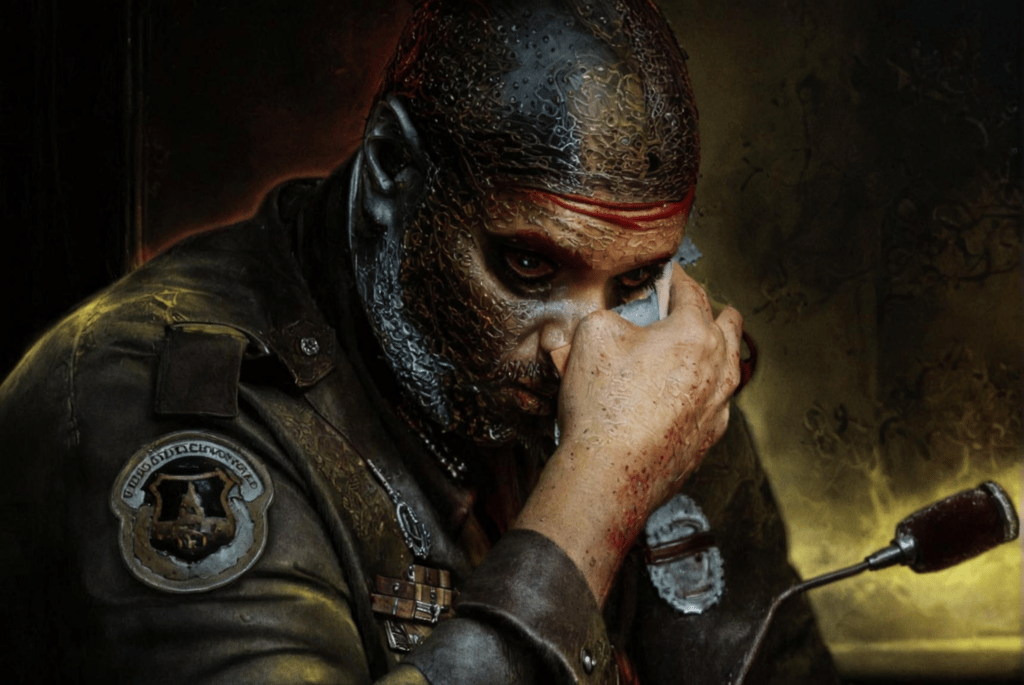
Larry Dunn #3
Speaking Truth to Power - When the chaos of January 6th finally subsided, Larry Dunn was left with more than bruises and exhaustion—he was left with memories that felt impossible to carry. The images replayed in his mind like a nightmare: the screams of his fellow officers, the sound of boots pounding through the marble halls, and the pure rage in the eyes of the rioters. But for Larry, it wasn’t just the violence that haunted him—it was the silence that followed.
DJT
1/4/20255 min read
Speaking Truth to Power
When the chaos of January 6th finally subsided, Larry Dunn was left with more than bruises and exhaustion—he was left with memories that felt impossible to carry. The images replayed in his mind like a nightmare: the screams of his fellow officers, the sound of boots pounding through the marble halls, and the pure rage in the eyes of the rioters. But for Larry, it wasn’t just the violence that haunted him—it was the silence that followed.
In the immediate aftermath, Larry thought the truth would speak for itself. The images of shattered glass, overturned desks, and officers bloodied in the line of duty were seared into the public record. Yet, within days, a troubling narrative began to emerge. Some politicians called the riot "a peaceful protest." Others suggested that the mob had been full of "patriots" who had gotten carried away. Conspiracy theories began to spread like wildfire—claims that the attack had been staged by political opponents or outside groups.
Larry watched the news in disbelief. He had been there. He had felt the sting of the insults, the crushing weight of the mob. He had seen their faces. These weren’t peaceful protesters—they were people who came to destroy everything the Capitol stood for. Yet the truth was already being twisted into something unrecognizable.
At first, Larry tried to keep his head down. He had never been one for the spotlight. His job had always been to protect, not to speak. But the more he heard the lies, the more it gnawed at him. He thought about his fellow officers—men and women who had risked everything to hold the line—and how their sacrifices were being erased by misinformation. And he thought about the rioter who had spat the N-word at him, how that hatred had cut deeper than any weapon.
Larry knew that staying silent meant letting others define what had happened. And so, he made a decision: he would speak out.
The first time Larry shared his story publicly, it was in a quiet interview with a journalist who had been covering the attack. Larry’s voice was steady but raw as he recounted what had happened. He spoke about the fear and the chaos, but also about the resilience of his fellow officers. He described the moment he was called a racial slur and how it felt like a punch to the soul. "I’m a Black man in America, and I’m a police officer," he said. "I signed up to protect people, no matter what. But that day, they didn’t see me as an officer—they saw me as an enemy because of my skin."
The interview spread quickly, resonating with people across the country. Letters and messages poured in, many of them thanking Larry for his courage. But with the praise came the backlash. Some accused him of being "divisive" or "politicizing the attack." Others sent death threats. Larry wasn’t surprised. He had seen firsthand how deep the division in the country had become. But he wasn’t afraid. "I stood up to a mob that wanted to kill me," he told a friend. "I’m not going to be scared off by people hiding behind a screen."
As the nation grappled with the aftermath of the insurrection, Congress announced plans to hold a series of public hearings to investigate the attack. When Larry was asked to testify, he didn’t hesitate. He knew the risks—he’d seen what happened to public figures who spoke out against powerful lies. But he also knew that if the truth wasn’t spoken plainly and boldly, it might be lost forever.
On the day of his testimony, the hearing room was packed. Reporters, lawmakers, and spectators filled the seats, their eyes trained on the witness table where Larry sat. Cameras flashed as he adjusted his microphone and took a deep breath. He was still healing from the physical wounds of that day, but he wore no visible armor—only a suit, a quiet strength, and the weight of the truth he was about to deliver.
Larry’s opening statement was simple but devastating. "My name is Larry Dunn. I am a United States Capitol Police officer, and I was there on January 6th."
He spoke slowly and clearly, his deep voice resonating through the chamber. He described the events of that day with unflinching honesty—the breach of the Capitol, the roar of the mob, the racial slurs hurled in his direction. "They didn’t just attack a building," he said. "They attacked everything this building represents. They attacked democracy itself."
Larry’s voice cracked as he recounted the moment he was called a racial slur. "I’ve worn this uniform for over a decade," he said, "and I’ve always known there were people who saw me as less than. But I never thought I’d hear those words shouted at me inside the Capitol." He paused, his hands gripping the edge of the table. "No one should have to endure that—not in this country."
The room was silent. Even the most hardened politicians shifted uncomfortably in their seats. Some stared down at their notes, unable to meet Larry’s gaze. He had stripped away the political spin and laid the truth bare.
When the questioning began, some lawmakers praised Larry for his service and bravery. Others, however, tried to downplay the significance of the attack or redirect the conversation. But Larry was unshakeable. "I’m not here to argue politics," he said firmly. "I’m here to tell you what happened. And if we don’t hold people accountable, it will happen again."
His testimony made headlines across the country. Social media was flooded with clips of Larry’s words, and his name trended for days. To many, he became a symbol of resilience and integrity—a man who had faced hate head-on and emerged stronger.
But Larry’s journey wasn’t without cost. The threats against him intensified, and he found himself the target of online harassment. Some accused him of being "a traitor" or "an attention seeker." Yet, through it all, Larry remained steadfast. "The truth doesn’t need to be convenient," he told a journalist during a follow-up interview. "It just needs to be told."
In the months following his testimony, Larry continued to speak out—not because he wanted attention, but because he felt a duty to honor those who had stood with him that day. He spoke at universities, police academies, and town halls, urging people to reject disinformation and stay engaged in the democratic process.
One of his most powerful speeches came during a remembrance ceremony for the officers who had defended the Capitol. Standing at the podium in front of a crowd of lawmakers, officers, and survivors, Larry spoke directly to the families of the fallen. "Your loved ones didn’t just serve—they stood for something," he said. "They stood for justice, for honor, and for every person who believes that this country is worth protecting."
The speech brought many in the audience to tears. Even as Larry walked away from the podium, the weight of his words lingered in the air.
Larry’s decision to speak truth to power wasn’t born out of ambition—it was born out of duty. He didn’t want fame or recognition. He wanted accountability. He wanted people to remember that the Capitol wasn’t saved by luck—it was saved by people like him, who chose to stand their ground even when they were outnumbered and outmatched.
Years later, when asked how he wanted to be remembered, Larry’s answer was simple: "As someone who did his job." But to those who heard his story, he was far more than that. He was a defender of democracy, a voice of truth, and a reminder that real courage isn’t loud—it stands tall in the face of hate and refuses to be broken.