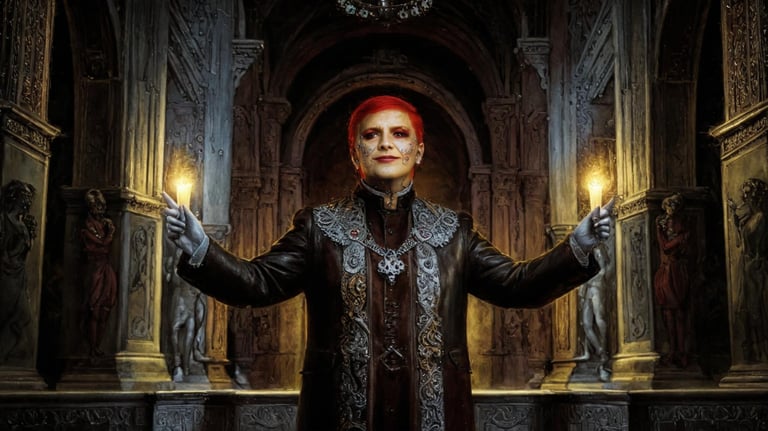
Mickey Johnston #4
A Nation on the Brink - Mickey Johnston sat alone in his living room, the only light coming from the television muted in the corner. The headlines were relentless—images of the New Orleans truck attack and the Las Vegas explosion played in endless loops, accompanied by speculation, outrage, and fear. The faces of the perpetrators, both U.S. Army veterans, stared back at Mickey from the screen. They weren’t foreigners or undocumented immigrants. They were not only Americans, they were Veterans..
DJT
1/2/20255 min read
A Nation on the Brink
Mickey Johnston sat alone in his living room, the only light coming from the television muted in the corner. The headlines were relentless—images of the New Orleans truck attack and the Las Vegas explosion played in endless loops, accompanied by speculation, outrage, and fear. The faces of the perpetrators, both U.S. Army veterans, stared back at Mickey from the screen. They weren’t foreigners or undocumented immigrants. They were not only Americans, they were Veterans.
Yet, here was Donold Grump, in a press conference earlier that day, pinning the blame on President Biden’s so-called “Open Borders Policy.” Mickey had listened in stunned silence as Grump twisted the narrative, his voice dripping with performative outrage. “These tragedies are the direct result of weak leadership,” Grump had said. “Under Biden, our borders were wide open. It’s a disgrace, folks. A disgrace.”
“Wide open to what?” Mickey muttered to himself, staring at his reflection in the darkened window. The perpetrators didn’t cross any border. They didn’t come from Mexico or any other country Grump regularly scapegoated. They were homegrown—veterans of a nation they had clearly struggled to reconcile with after their service.
The lie gnawed at him. Grump didn’t even believe his own rhetoric. Mickey knew that for a fact. In private conversations, Grump had called the “Open Borders Policy” a “genius move” for the Republicans. “It’s all rhetoric, Mickey,” Grump had said once, lounging in his gold-trimmed chair. “Gets the base riled up. Wins elections. And the best part? It doesn’t even have to make sense.”
Mickey felt his stomach turn at the memory. He had stood there, nodding politely, convincing himself at the time that it was just politics as usual. But now, with bodies in the streets and communities fractured by fear, the consequences of that rhetoric were impossible to ignore. How many people had to suffer for Grump’s so-called genius?
“Is it genius,” Mickey whispered, his voice cracking, “or is it evil?”
He leaned forward, resting his head in his hands. His thoughts spiraled into a deep, unsettling question: Did Donold Grump even have a soul? He was supposed to be the leader of a nation, but all Mickey saw was a man obsessed with his own power and image, a man willing to stir hatred and division to stay on top.
Mickey’s mind wandered to the reports pouring in from across the country. People, emboldened by Grump’s rhetoric, were attacking anyone who looked like an immigrant. “It’s Grump’s America!” one man had shouted while beating a gas station attendant in Arizona. The phrase was popping up everywhere, a sick justification for violence and intimidation. Mickey’s phone had been flooded with reports from colleagues and activists describing hate crimes on the rise, people emboldened to act on their worst instincts because they felt they now had permission.
“And Grump doesn’t care,” Mickey said to the empty room. “He doesn’t care about the people getting hurt. He doesn’t care about the truth. He only cares about himself.”
The thought felt like a betrayal. Mickey had clung to his faith in Grump for years, convincing himself that the President-elect was part of some greater plan. “God works in mysterious ways,” Mickey had told himself, even when Grump’s actions seemed to contradict every principle Mickey held dear. But now, that faith felt hollow.
Mickey stood and began pacing the room, his hands gesturing as if he were delivering a sermon to an unseen congregation. “How does a man claim to represent God and act like this?” he asked, his voice rising. “How does someone who says ‘God bless America’ turn around and bless hatred instead?”
He stopped in front of the television, his reflection overlaying the silent news footage. “What kind of America are we building? What kind of people are we becoming?”
His words hung in the air, unanswered. He dropped onto the couch, his body heavy with exhaustion. The questions didn’t stop. They came at him like waves, each one crashing harder than the last.
Had he been blind all along? Was Grump always this man, or had he become something worse over time? Mickey thought back to the early days of the campaign, when Grump’s brashness had felt like a necessary disruption to a stagnant system. “He speaks his mind,” Mickey had told himself then. “He’s shaking things up.”
But now, shaking things up felt more like tearing things apart. And Mickey had been complicit. He’d stood behind the podiums, echoed the talking points, defended the indefensible—all because he’d believed it served some higher purpose. Now, he wasn’t so sure.
“Maybe I’m the one who’s lost,” Mickey whispered. “Maybe I’ve been part of the problem.”
The thought hit him like a blow. He pressed his palms to his eyes, trying to shut out the torrent of guilt that threatened to overwhelm him. If Grump was the problem, what did that make Mickey? He’d given his loyalty, his voice, his platform to a man who seemed incapable of compassion. Did that make him complicit in the hatred spreading across the country?
Mickey thought about the Two Commandments he had been pushing for in Congress: love God and love your neighbor. How could anyone reconcile those words with the reality of “Grump’s America”? How could he preach love when his party’s leader thrived on division?
His faith felt like a fragile thread, stretched thin under the weight of his doubts. He’d built his career on the belief that God had a plan for him, that every step he took was guided by divine purpose. But now, that purpose felt distant, obscured by the chaos Grump had unleashed.
Mickey’s eyes drifted to the Bible on the coffee table. It was a constant presence in his home, its pages worn from years of study and prayer. He reached for it, his hands trembling, and opened it to Matthew 22. The familiar words stared back at him:
“Love the Lord your God with all your heart and with all your soul and with all your mind.”
“And the second is like it: Love your neighbor as yourself.”
Tears welled in Mickey’s eyes. “Have I failed You?” he whispered. “Have I been blind to what You’ve been asking of me?”
The silence in the room was deafening. Mickey closed his eyes and took a deep breath. He didn’t have the answers, but he knew one thing: he couldn’t keep walking the same path. Something had to change.
His phone buzzed on the coffee table, jolting him from his thoughts. It was a message from a colleague: “Grump’s rally tonight was... intense. You should watch the clips.”
Mickey set the phone down without replying. He couldn’t bear to hear more of Grump’s rhetoric, not tonight. Instead, he sat in the stillness, the weight of his doubts pressing down on him.
For the first time in years, Mickey felt unmoored from everything he thought he believed in—his faith, his politics, his purpose. But another thought lingered at the edge of his mind, faint but persistent: Maybe it wasn’t too late to change. Maybe it wasn’t too late to fight for something better, something true.
The question was, would he have the courage to do it?